
The Pact
Exploring Firehouse Theatre’s "Buried Child" Through the Dramaturgy of Horror

“‘what if there was a house and it really fucking hated you’ is such a fun brand of horror. what if there was a house and it really fucking hated you, huh. what would you do then buddy”
– tumblr user @dashedwithromance, May 21st, 2023
It’s 1978, and you’re a beautiful, witty, empathetic, all-around-all-American girl on an impromptu road trip with your short-lived situationship, walking up the drive to an old, odd house where—he says—his grandparents live. You walk inside, quickly sense that All is Not Well, and suddenly you’re doing what you must to survive, abandoned to the enraged ghosts and wondering if the real monster has been in the driver’s seat beside you all this while.
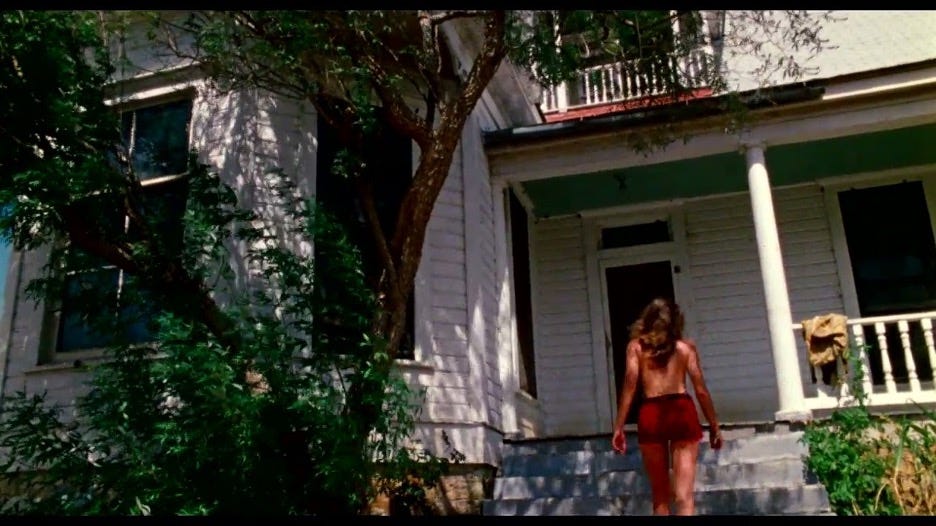
An intriguing alignment between Firehouse Theatre’s Buried Child, helmed by Chelsea Burke, and the quintessential dramaturgy of classic horror movies is easy to detect, stemming both from the text itself and the interpretive details Burke, her creative team, and her actors highlight in a beautifully orchestrated production. By examining the show beat by beat, I hope to underline these parallels both in homage to this particular iteration of the play (which I saw three times), and for the delight of better understanding an exemplary play in the mid-century American theatre canon.
Before proceeding, I’d like to let you know that this essay makes reference to horror films that contain disturbing, violent, and sexual subject matter, though minimal violence or sexuality is explicitly detailed by this essay itself. It also contains spoilers for The Texas Chain Saw Massacre (1974), Friday the 13th Part I (1980), Friday the 13th Part II (1981), Halloween (1978), The Last House on the Left (1972 but not the remake), Ready or Not (2019), Happy Death Day (2017), and It Follows (2014), and, of course, Sam Shepard’s play Buried Child (1978). This essay is not intended for readers under the age of 13, and individual discretion is advised as to how best to interact with the subject matter explored herein.
Setting the Scene
Horror is rife with iconic houses, and this one is no exception.
The production’s lighting, soundscape, and scenic design, created by Michael Jarett, Candace Hudert, and Frank Foster respectively, offer a tangible sense of place and an intangible sense of dread. The wallpaper is almost Kubrickian in its intricacy, with a mercifully cooler color palate, though the lighting lends a sickly quality to the cool, blue, floral pattern and the peeling white painted trim. The muffled sounds of the television—which gorgeously yet subtly swell to underscore a particularly poignant and hopeful speech at the midpoint of the play—waltz with delicately flickering lights that suggest Dodge’s selection of television programming without ever detracting from the action of the scene.
One quickly notes that something is missing; once there were a dozen or more photos hanging up on the walls, but they’ve all been removed or perhaps repatriated. We don’t ever get to see this collection of photos, but we are invited to imagine it, first by its copious absence and then again when our Final Girl enters the scene to bear off-stage witness to the off-stage lives of the other characters, allowing us to fill in the carefully orchestrated blanks that Shepard leaves for us, clues to the mystery of what’s lurking beneath the floorboards, behind the closed doors, and out back in the yard.


Shot-for-Shot
Structurally, Buried Child fits neatly into the playbook of any archetypical horror movie. The first act presents us with stasis: the world as it exists before fear arrives (or perhaps merely before it overtakes us), the second act introduces an element of chaos, the Horror Emergent, and the third act is the collision of worlds, the catharsis of the living and the dying and the dead fighting it out for the grand prize of meeting the sunrise as the credits roll. However, “stasis” in the case of Buried Child is not about our aforementioned “Final Girl”—in fact, she’ll be the intruding chaotic element, but more on that anon—for this haunted house story starts already inside the house, where the ghosts are going about their daily business. They don’t simply pull on their Halloween masks and shout boo when they see a fresh face appear on the porch; in the absence of an outside agent, they have to haunt each other.
These particular ghosts are called Dodge and Halie, played by David Bridgewater and Boomie Pedersen respectively. In different lighting, the setup is a single-camera sitcom: the nagging wife and the curmudgeon husband lament their profligate children, snipe at each other about past slights, and entertain the grander esoteric questions of life, like whether or not pain pills are compatible with fanatical Christianity and “Are we still in the land of the living?”, the latter of which is a pertinent question indeed.
We are, perhaps a little reluctantly, charmed by Dodge; he is certainly a “man of his time”, and might kindle in us memories of our own fathers, grandfathers, and other elders whose societally endorsed entitlement has shrunken into powerless petulance as time marches on. He is not necessarily malicious, and we could probably outrun him, but that doesn’t make him good, and to spoil the ending, he’s our killer. But in this house, in this family, in this play, there are perhaps worse things one can be.
Even more reluctantly are we compelled by Halie, who commands our notice even before we see her. Barely competing for Dodge’s attention and easily winning ours, Halie’s voice echoes from upstairs, a disembodied chiding, gloating, and reminiscing matched with Dodge’s quips and quibbles. Serving structure and story in one go, Halie leads us through the family tree with prompt clarity, introducing us facilely to her sons: troublesome Tilden, foolhardy Bradley, and all-American Ansel. These descriptions as provided by Halie bear little resemblance to the men we’ll meet in a moment, and her position as an unreliable narrator of her own life aligns her with even earlier horror protagonists, like the narrators of Edgar Allan Poe’s The Tell Tale Heart or Henry James’s The Turn of the Screw, or the eponymous Jane Eyre.
Halie is in turns excruciatingly specific in her recollections and curiously forgetful of the grander scope. She recalls in vivid sensory detail the “cheap cologne” worn by her new in-laws at her son Ansel’s wedding and the bougainvillea flowers she saw on an outing to the races, but she can’t distinguish whether it was in Florida or California. And we might be tempted to accept her claims that Ansel was dead to begin with, but as her plans for his memorial swell from a plaque to a statue in a single sentence, we wonder just how much of the story she’s embellishing. It’s a catching sickness: by Dodge’s own reckoning, this household has many sons, and he and we seem easily to lose track of just how many, resulting in an ever-shifting goalpost of inheritance, legitimacy, and legacy.
But one of the remaining sons is definitely Tilden, played by Andy Braden, who enters rain-soaked and cradling a massive heap of corn. Like the children in this family, the corn’s provenance is questionable. Tilden says he picked it from out back, but Dodge denies that anything grows out back at all, and Halie accuses Tilden of having stolen it. Both parents seem to think this more plausible than any supernatural explanation, and if they are to be believed, their fears are not unfounded, given that Tilden got into some unspecified trouble in New Mexico before returning home, something which Tilden himself will corroborate later on. But he certainly doesn’t question how the corn came to be, but simply puts it to its natural purpose: being shucked. Tilden’s gentle awkwardness, straightforward lines of logic, and unshakable dedication to digging up the backyard despite copious warnings to the contrary are tremendously endearing, but he’s not without his own peculiarities. Upon finishing his corn-shucking, he scoops up the husks and artistically deposits them atop the sleeping Dodge, even going so far as to carefully place a few on the brim of Dodge’s cap, before disappearing as he came, leaving us with more questions than answers.
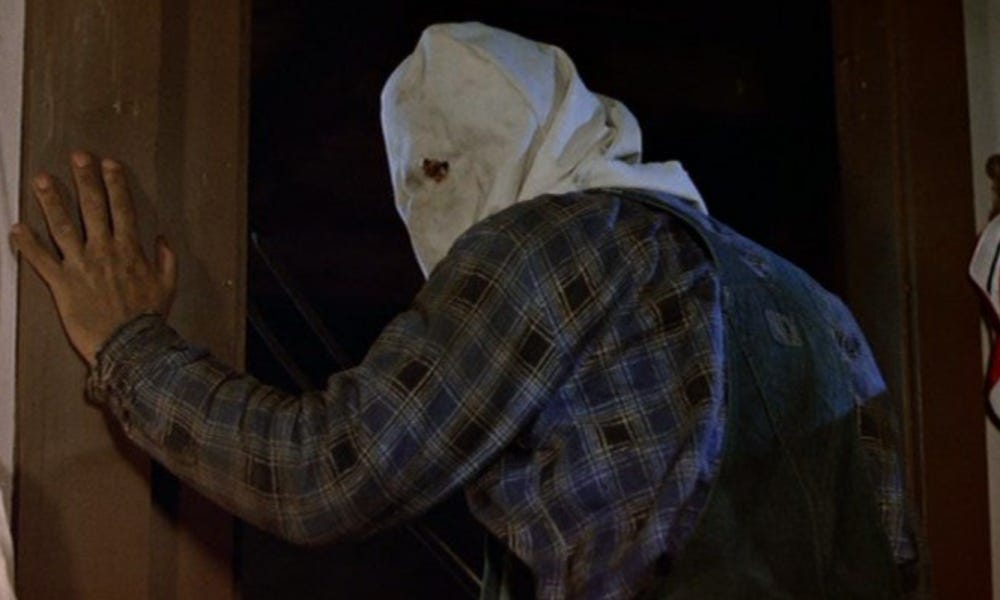
Then another hulking figure traverses the rain to join us in the haunted house: Patrick Rooney, with a lurching, careful gait, the hood of his flannel jacket up, evoking an early-film Jason Vorhees before the iconic mask came into play. This, we may presume, is the promised Bradley, whom we know is intending to come over, ostensibly to cut Dodge’s hair despite Dodge’s grumblings to the contrary. We’ll recall from Dodge and Halie’s earlier conversation that Bradley suffered an accidental (?) injury with a chainsaw resulting in the loss of his leg, and he now uses a prosthesis, and it seems little has been done to make the house more accessible to him. On the porch, Bradley trips and falls, and at each performance I attended, the audience flinched as if it were Rooney, not Bradley, who had taken the spill. The relief that it’s all part of the show is equally palpable, and short lived: “Always some obstacle” he mutters, and we don’t know the half of it.
Bradley reacts to the copious corn as anyone might: he’s surprised, confused, and a little irked to see his ailing father thus bedecked. Bradley puts himself to trouble to clean up the husks, and we begin to trust him: perhaps someone has arrived who can help us make sense of what’s happening in this house.1 He takes more pains than he will receive thanks, and though it’s painful, he does it. But the bait and switch, the prestige and the trick, is a hallmark of this play, and just as we think we might be inching towards safety and sanity, the prophesied clippers come out, and Bradley begins to shave the sleeping Dodge’s head without the consent Halie had earlier promised. Harvest is over and winter is here.
Invasion
As promised, Act II begins with the arrival of our “Final Girl” Shelly, played by Ashley Thompson. She’s perfect for this period piece, just as she was in Yes, And!’s extraordinary Dr. Ride’s American Beach House earlier this year, immaculately styled for the 1970s by costumer Elizabeth Weiss Hopper, and just as spot on in her mannerisms and vocal choices, invoking Jamie Lee Curtis in Halloween (1978), Olivia Hussey and the sorority sisters of Black Christmas (1974), and Jocelin Donahue in The House of the Devil (2009 by way of a 1980s pastiche).


Shelly has been drawn into this tense situation as a guest of Tilden’s self-proclaimed son Vince, played by Adam Turck. Vince explores the house, notes the missing photographs and then confirms that they’ve all been rehung in Halie’s room upstairs, proving to us that the devil is in the details for this production. The most critical detail, unique to Chelsea’s interpretation? The phone doesn’t work. Vince tries to dial the operator, and gets nothing. In classic horror movie fashion, it’s not dire at first blush, but it will be important later. Vince spins Shelly some “Norman Rockwell” fantasies of his childhood that, perhaps unsurprisingly by this juncture, immediately go contested by everyone already in the house, who don’t recognize him. Shepard by way of Shelly delivers us a platter of patented horror film dialogue, variations on a theme of “Maybe we ought to go…this isn’t going to work out; I’ve got a strong feeling…I don’t want to stay here. In this house…I’m fuckin terrified! I wanna go!”
She’s completely correct on all counts, and it feels pertinent to mention at this juncture that The Texas Chain Saw Massacre (1974) is technically a home invasion movie, and the invaders are the road-tripping youths who later become victims to the family of murderers into whose house they have stumbled. Responding to an unarmed and accidental incursion on private property with torture and cannibalism is an overreaction to say the least, but someone was there first, and we’ll get back to that.
Dodge and Tilden’s want of welcome sparks anger bordering on violence in Vince; shy of Bradley and his clippers, which have done some damage to Dodge’s scalp as well as his pride, Vince becomes the most physically dangerous person in the house, slamming his fist against the wall, shouting at Shelly, and even putting his hands on her in a less than respectful way. She shoves back, already showing the sort of spine we’d expect in our horror movie heroine, and he backs off, agreeing to go buy Dodge a bottle of whisky in the hopes it will help pave the way for recognition. He takes the car when he goes, which, in another clever blink-and-you’ll-miss-it foreboding foreshadowing cut to close up, means Shelly is stranded with these strangers: no car, no phone, no way out.
Shelly and Dodge are almost immediately at odds, but eventually maneuver their way to a safe détente, and despite Vince’s earlier protests, Shelly uneasily befriends Tilden, who is enchanted with her, not in a romantic sense, but with a childlike fascination for something beautiful and “foreign”. He shyly asks to touch her coat, which he cradles like the corn (and the carrots he just brought in), speaking more to the coat than Shelly as he dreamily describes his driving days, being a carefree kid with the liberty to go anywhere, see anything, even things he’s not supposed to see, in this case the secrets of nature, of small living things upon which he did not intrude but rather drove on. But he’s trapped; they all are, now.
He begins to tell her further of a small living thing that once occupied his arms: a baby of uncertain parentage and even more muddled surcease. But Dodge interrupts him, protesting Shelly’s innocence on one hand and her “outsider” status on the other; she’s a potential casualty and a potential threat, and so she doesn’t get the complete story yet, but the seed has been planted.
Men, Women, and Chainsaws2
The mutual, truly Platonic tenderness between Shelly and Tilden is a beautiful oasis in a bleak play, and another startling poignant parallel to contemporaneous horror films.
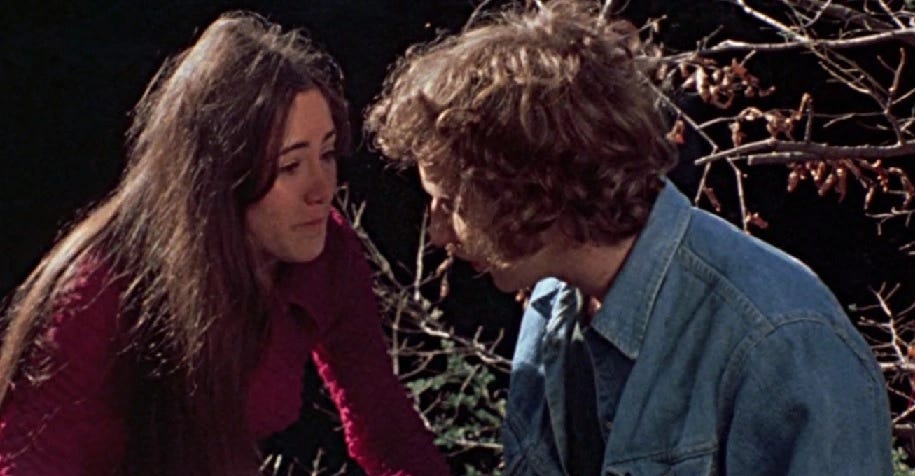
In the original incarnation of Wes Craven’s The Last House on the Left (1972), central character Mari Collingwood gently endeavors to connect with Junior, the son of one of her murderous assailants, Krug. Like Tilden, Junior is implied to have a cognitive or developmental delay or disability, and he has reluctantly gone along with atrocities committed against Mari and her friend, unable to advocate for himself or for the victimized girls in ways meaningful to his father and the film’s primary antagonist, the brutally cruel Krug. When Junior is left behind to guard her, Mari brilliantly endeavors to psychologically distance Junior from Krug. She offers him her necklace, and Shelly offers Tilden her coat, not just to hold but to keep. Mari, in keeping with her hippy flowerchild spirit, rechristens Junior as “Willow”, saying it’s “…because you’re kind of beautiful and you shake when the wind blow—Krug’s the wind”.
This is the most direct and compelling mirror of all, for when Bradley returns to the house, Tilden is immediately stymied by Bradley’s terse, forceful language and intimidating physicality. Bradley takes advantage of the mental advantage he has over Tilden and the physical advantage he (for the moment) has over Shelly and Dodge, and scares Tilden out of the room with a shout, leaving Shelly without an ally. “He was always so scared. Scared of his own shadow. Some things are like that,” Bradley scoffs. “They just tremble for no reason. Ever notice that? They just shake.”
Both the play and the film explore cycles of violence: how perpetrators can become victims and vice versa, how we shake and are shaken. And Bradley is the wind that shakes Tilden, for now, and he does far worse by Shelly. Backing her up against a wall, Bradley forces his fingers in her mouth, and the horror only freezes us further as we wonder if he will subsequently put his fingers in his own mouth, heaping violation atop violation. The threat proves merely provocative in this instance, but we’re no less disturbed when he wipes his hand on the rabbit fur coat, snatched from Tilden as he fled.
We cut away to intermission, leaving us in fifteen minutes of fear for Shelly’s safety, but, by the time we’re back for Act III, Bradley is asleep on the couch, and Shelly is—more or less—alive and well, having run and hidden outside until her assailant was disarmed, or in this case dislimbed in a different way. We see for the first time the prosthesis which so pains him, removed to allow for more comfortable sleep.
Disability and horror make for mercurial bedfellows: the genre can in turns represent, exploit, interrogate, uplift, mock, and lionize disabilities of all kinds. It requires a deft, informed, and inclusive mindset, as well as excellence in storytelling craft and technique, to ensure that in depicting disability in horror, we unequivocally uphold that disability itself is not a crime or a horror: individual and systemic responses to disability can be and often are.
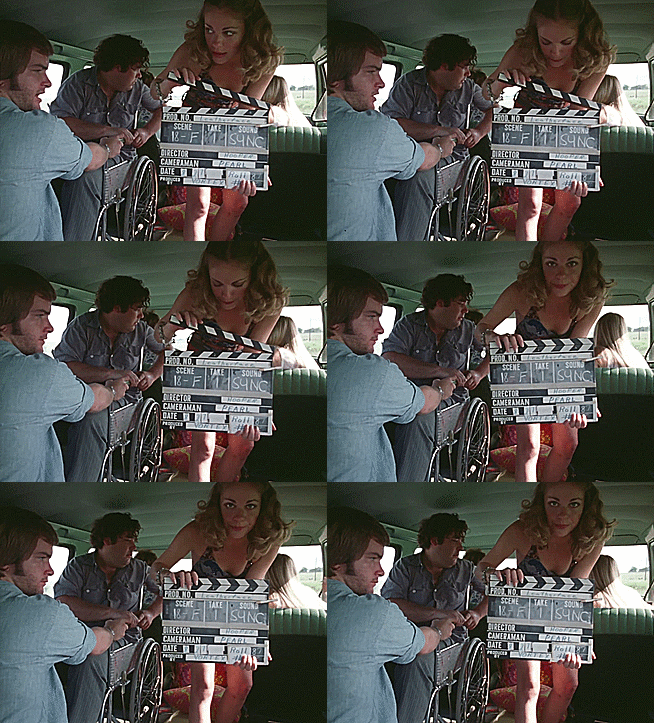
The Texas Chain Saw Massacre (whose punchy title belies just this sort of deftness) features the character Franklin, who uses a wheelchair, and who by virtue of his writing and the performance by Paul A. Partain is allowed to be more than one thing at once. He’s a brother beloved and begrudgingly loving of his sister, a sensitive person disappointed by the limitations of an inaccessible world and his sometimes careless friends, an irritating grump causing rolled eyes on a road trip, and as valiant a victim as any of his fellow fighters against the murderous cannibal clan, though it’s only his sister Sally who survives. No doubt, the film is imperfect and incomplete in its interpretation of disability justice in terms of what should be a perpetually progressing understanding, and Franklin is also a deeply compelling individual who is both inherently and incidentally a character with a disability. His use of a wheelchair is important to his characterization, explored on more than just a surface level, and also not the only defining feature of his character.
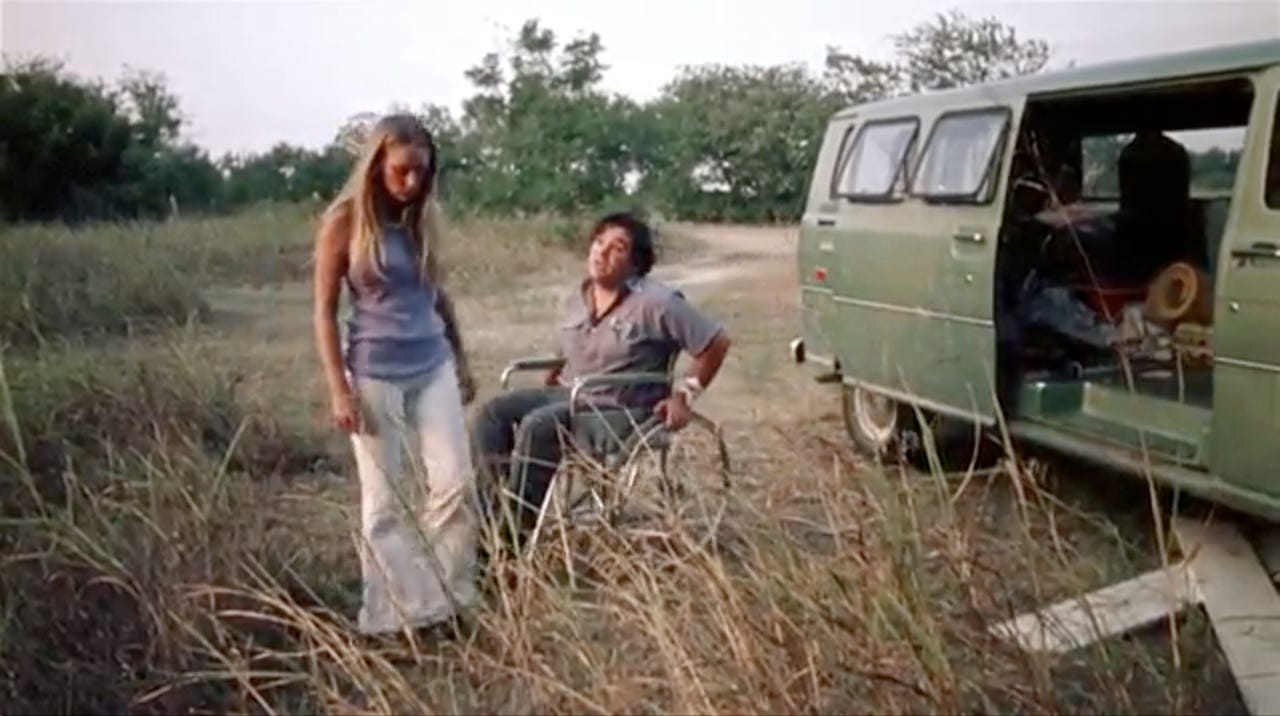
The same is true for Tilden and Bradley, created just a few years after Franklin. Their disabilities inform their characters with a weight equal to their other given circumstances, and also speak to a broader plight of their marginalized communities. In 1978, audiences might have recognized in Tilden and Bradley the tragic plight of veterans returning from the Vietnam War, and in 2024, we may draw our own parallels to similar injustices at home and abroad.
Collision and Catharsis
To catapult us through the rest of Act Three, we’ll first make another little mention of Friday the 13th, because no matter how one interprets the final sequence on Camp Crystal Lake, Jason Vorhees is not the slasher. The real villain is his mother.
Halie, who departed in Act I to see about that statue, returns arm in arm with, ostensibly, her lover, the Right Reverend Dewis (played by Doug Blackburn). She’s tipsy, belligerent, and disturbed by the intruder in her home, showing no solidarity with or sympathy for Shelly, nor any of her family. Halie dismisses Dodge’s protests and berates the increasingly woebegone and angrily ineffectual Bradley, for his assault of Shelly—not because it hurt her, but because he has “no idea what kind of diseases she might be carrying”. As so often proves true in horror films, the poisoned air in the house infects the heroine, and forced onto the defensive, Shelly succumbs to the cruelty she’s been experiencing and steals Bradley’s prosthetic leg, and threatens to use it as a weapon, even as she shouts, “I’m not threatening anyone”. With Bradley physically incapacitated and increasingly emotionally vulnerable under Halie’s continual verbal abuse, Dodge immobile in his chair, and Reverend Dewis trying his best to extricate himself from the situation, Shelly forces the issue of the secret, but Dodge needs little more persuasion to reveal it, even as Halie and Bradley desperately entreat him to keep their “pact”3 never to speak of it again.
With bridled emotion and a profound cogency, Dodge tells the truth: Halie took advantage of Tilden and became pregnant. Dodge gruesomely describes her painful labor and childbirth, and the horrors that followed: eventually, Tilden’s palpable love for the child made Halie’s shameful, reprehensible act too obvious, too public, so Dodge drowned the baby, and buried him in the backyard, and it’s his infant son that Tilden’s been seeking as he dug through those miraculous crops.
Tilden’s other son (probably…?) returns, himself drunk, fully blossomed into the familial tendency to violence as he throws and breaks glass bottles, rips open the window screen, and monologues with an intense introspection about his attempt to leave it all—including Shelly—behind by driving as far away as he could. But the road, whether supernaturally or metaphorically, only led him back here, back home. And intruder or not, it is Vince’s home now, as Dodge, in a final act before he dies—quietly and with a strange sense of serenity—wills the house and all that haunts it to Vince.
Still, Shelly entreats him to escape with her, but he refuses, and as she finally flees to the car, he bids her farewell with another line that could have been stolen from a slasher: “You’ll never make it.” But she will, I think, and she’ll be able to shake off the brutality she adopted in order to survive, too, for as she says in a gorgeous parting sentiment: “I’m not even related.” Our Final Girl is free, but this story ultimately does belong to the house itself, so we won’t follow her past the porch.
Vince chases Bradley away, dons Dodge’s cap, Tilden’s shirt, and wraps himself in Bradley’s blanket, settling into his new role in the cycle, an amalgamation of the men who came before. But those exterior trappings don’t mean he must let the poison sink in—a last look at the hat in his hand suggests Vince might be able to burn or bury at least a little of his bequest after all.
Tilden then returns, having at last successfully unearthed the tiny skeleton of his buried child. He tenderly carries the baby up the stairs towards Halie’s room, where she has retreated, unknowingly shouting down that she can see the garden thriving in the yard below as Tilden delivers up to her an unspecified fate, either of redemption or retribution.
Like in many a fine horror film, some endings are best left to the individual imagination. And to my eyes, Firehouse’s Buried Child offers us a happy, hopeful ending: the day has come despite all odds, a young woman escapes with her life, and a maligned man at last locates the missing piece of his heart, and can now confront his grief and the evil that caused it, and start a new chapter of his life. Tilden brings his child up into the light as the rain fades, the corn flourishes, and Halie prophecies the downfall of her own power as she remarks on the fragile strength of the miraculous crop, “Strong enough to crack the earth even.” Strong enough to change the world.
Conclusion: The Pact
Sam Shepard’s Buried Child is, if we must apply a parameter, a work of magical realism. We certainly can try to “script analysis” our way to a rational explanation for these events. We can make a timeline and a family tree, put up a Pepe Silvia board on the wall, theorize wildly like we’re trying to predict when Reputation (Taylor’s Version) will be released.
What if this is purgatory? What if it’s a horrific Happy Death Day (2017) cycle that the family must repeat each day, resetting in endlessly frustrating variations until they learn their lesson? Today, there’s corn and carrots in the backyard; tomorrow, it’s gold dust in the riverbed; next week, rabbits come running out of the woods. What if Shelly truly is a “free agent” – a regular young woman who had the bad luck to fuck a ghost and wind up at the world’s worst family reunion? She escapes on the cycle we see, but will the next day’s heroine have the same luck?
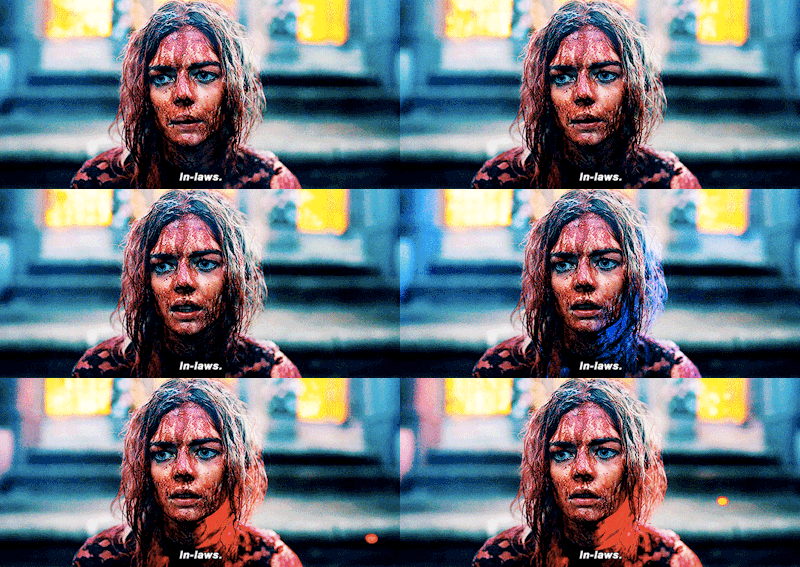
It's a tantalizing line of inquiry, and one I’ve delighted in imagining, but I always return to the plot precisely as it is presented to me by Shepard, Burke, and this production’s whole team, with no further editorialization needed. And what I find there, as is often true of horror stories, is a parable: an instruction, a warning, a story about something larger than itself, yet one which relies on specificity in order to evoke empathy and understanding from the audience.
What if there was a house and it really fucking hated you, and the house was your entire country? What would you do then, buddy? For the United States of America is the ultimate haunted house story, beginning with a home invasion: we, the white settlers, barged into a home that didn’t belong to us, hacked and slashed our way through the rightful inhabitants, and buried the bodies in the backyard, making a pact that, when company comes around, “Nothing’s wrong here! Nothing’s ever been wrong! Everything’s the way it’s supposed to be! Nothing ever happened that’s bad. Everything is all right here! We’re all good people! We’ve always been good people. Right from the very start.”4
The pact is white supremacy, and anyone can sign on, hoping against hope that they will be the lucky exception who benefits rather than suffers in a system built to consume rather than create. This pact has been depicted hundreds of times in hundreds of ways across the history of horror as a genre. There are the literal deals with the literal devil spanning Marlowe’s Doctor Faustus (c. 1592-3) to Ready or Not (2019), or the implicit promise to never speak of this again that underlies the Nightmare on Elm Street franchise (1984 – 2010) and I Know What You Did Last Summer (the 1973 book and 1997 film adaptation), or the simple unstated willingness to let someone else suffer to spare yourself like It Follows (2014). In fact, it is the ways in which the pact fails even the most ostensibly privileged, forcing them into cycles of violence and victimization that Sam Shepard explores in Buried Child.
Halie, our allegory for America, denigrates the men of her household who fail to live up to virulent false ideals of masculinity—the poor and rural (Dodge), the disabled and disaffected (Bradley), and the gentle-hearted (Tilden)—while lauding the best son there can be: a bronze statue with a basketball in one hand and a rifle in the other, too dead to protest this one-dimensional version of being a man. And likewise, so apt for our time that it’s almost laughable, corrupt clergyman Father Dewis earns her attention and, presumably, the physical “reward” of taking her side, while promising newcomer Vince, who has stolen money, trashed the house, and physically harmed Bradley is deemed “an angel”. She turns these men against each other, when they ought to be aligned in fighting her, and crafting a better way to live free from the horror she sews in order to preserve power.
Men deserve more than to be ground to dust on the frontlines of endless war, or to work under the crushing heel of corrupt economic systems, or else to perpetuate the original sins of our nation from their bunkers and glass-walled offices as a substitute for true safety and community. We all deserve that.
True, our house is haunted by our own past misdeeds, and there is a sacred graveyard beneath our careless feet, but I for one still hope that even as calamities of our own making rain down upon us, the sun will return and this stolen ground will one day teem with new life, if we’re willing to see our sins out the in open, to hear them hit the air, and take the necessary steps to repair the harm we’ve done.
Thank you for reading!
In a perfect parallel to this structural button on the first act of a three-act play, Rooney, (understudying Alex Harris) as Mike in Chandler Hubbard’s Roman à Clef, which immediately preceded Buried Child in Firehouse’s season, made a similar end-of-act-one entrance, but Mike did turn out to be the grounded Everyman whose arrival brings clarity and realism crashing into the cryptic, surrealist world of the play-within-the-play Apple, Tree: Far From, Not. The congruence between Roman à Clef and Buried Child makes them a superb double feature of the season, and seeing the two in tandem deepened my appreciation for and curiosity about each. But that’s more matter for its own essay!
Carol J. Clover’s book Men, Women, and Chainsaws gave rise to the notion of the “Final Girl”.
Shepard by way of Bradley, Buried Child p.66 (revised Dramatists Play Service edition)
Shepard by way of Bradley, Buried Child p.65 (revised Dramatists Play Service edition)